|
Getting your Trinity Audio player ready...
|
June 1, 2026.
One of the most insightful sessions at LeverageCon was not centered on interest rates, capital markets, or loan production. Instead, it focused on something more structural: how the private lending industry is evolving as it continues to grow.
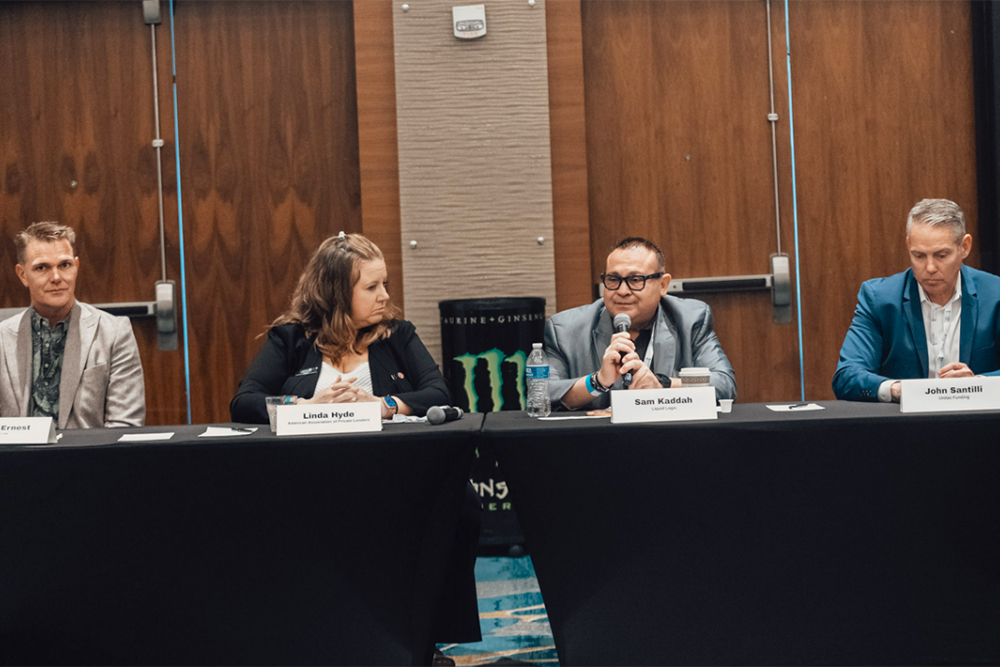
The AAPL Mid-Year Update featured Linda Hyde, President of AAPL; Steven Ernest, Partner at Fortra Law; Sam Kaddah, President & CEO of Liquid Logics; and John Santilli, Chief Production Officer at Unitas Funding LLC.
Together, the panel offered a candid look at the challenges and opportunities facing private lenders today, with recurring themes centered around education, ethics, fraud prevention, government relations, member accountability, and the increasing institutionalization of the private lending space.
AAPL’s Growth and the Need for Industry Infrastructure
Linda Hyde opened the session by highlighting AAPL’s continued growth in both scale and impact. She explained that the association has expanded from what was once a lean internal team into a broader operational structure supporting programming, partnerships, member services, events, content, and strategic initiatives.
That growth, she noted, has allowed AAPL to move from good ideas into actual execution across different areas of the organization.
A key part of that progress has been the work of AAPL’s committees. According to Hyde, these committees are no longer passive discussion groups. They are actively involved in shaping standards, education, advocacy, fraud prevention, member resources, and initiatives designed to help the industry respond to a rapidly evolving environment.
The broader message was clear: as private lending continues to grow, the industry needs stronger infrastructure, higher standards, and more coordinated leadership.
Committees as a Driver of Standards

AAPL leaders emphasized that the association’s committees are playing an increasingly active role in the industry.
The discussion touched on several areas where committee work has become especially relevant, including education, ethics, fraud prevention, government relations, background checks, member verification, and enforcement of professional standards.
Sam Kaddah spoke about the importance of maintaining quality within the association as it grows. He emphasized that AAPL is not simply about allowing anyone into the organization, but about supporting ethical participants who are committed to sound practices, education, certification, and the long-term quality of the industry.
He also noted that higher ethical standards must have real meaning. In some cases, that includes corrective action when members fail to meet expectations.
The message was not exclusion for the sake of exclusion. It was about protecting the value of AAPL membership and ensuring that the organization continues to represent trust, professionalism, and credibility.
Education Remains the Foundation

Throughout the panel, education emerged as one of the strongest and most repeated themes.
AAPL leaders described education as essential not only for new participants, but for professionals across the entire private lending ecosystem. That includes brokers, loan officers, lenders, servicers, fund managers, capital providers, and service providers.
John Santilli emphasized that AAPL has created significant educational resources for professionals entering or growing within private lending. He described the association as a place where participants can learn the fundamentals, understand best practices, and avoid trying to navigate the business alone.
The panelists also stressed that education is not limited to introductory content. As private lending becomes more complex, education is needed across the full lifecycle of a transaction: origination, underwriting, processing, servicing, capital structure, fund management, and exits.
The takeaway was simple: private lending still offers flexibility, but flexibility should not mean operating without standards, training, or discipline.
Fraud Prevention Has Become a Central Priority

Fraud prevention was one of the most important topics discussed during the session.
Steven Ernest, who serves on AAPL’s fraud-related committee work, explained that fraud has become a more visible and urgent issue in private lending in recent years. He noted that fraud is not merely a theoretical concern. It is present in the market and requires practical tools, awareness, and industry-wide education.
The conversation referenced common fraud risks such as straw buyers, borrower misrepresentation, suspicious transaction patterns, and other schemes that can expose lenders to significant losses.
AAPL leaders discussed several ways the association is working to address those risks, including webinars, white papers, fraud alerts, training videos, and practical resources designed to help members identify red flags before problems escalate.
Ernest also mentioned educational content focused on straw buyers and fraud avoidance, emphasizing the importance of giving lenders tools to protect their capital and respond more effectively when problems arise.
The repeated message was clear:
Trust, but verify.
Why AAPL Does Not Maintain a Blacklist

One of the most practical discussions came during the Q&A, when the topic of a potential industry “blacklist” was raised.
Steven Ernest addressed the issue directly. He explained that while a list of known bad actors could be useful in theory, it creates serious legal, ethical, and procedural concerns.
The panel discussed several difficult questions:
- How does someone get placed on the list?
- Who verifies the information?
- Could the list be abused by competitors?
- How does someone get removed from the list?
- Is there a fair process for review or correction?
Because of these concerns, AAPL leaders explained that the association does not maintain a formal blacklist.
Instead, the discussion pointed toward more structured and fair approaches, such as working with rating-style models, verification systems, or trusted information-sharing mechanisms that protect identifying information while still helping members recognize risks.
The goal is to support fraud prevention without creating a process that could be unfair, unreliable, or legally problematic.
Ethics Is More Than Compliance

The ethics discussion went beyond general statements about professional conduct.
AAPL leaders described ethics as part of the industry’s risk-management framework. Ethical conduct includes transparency, responsible borrower interactions, truthful representations, proper use of information, and professional behavior across the transaction process.
Sam Kaddah emphasized that ethics is not simply about internal principles. It affects how members interact with borrowers, counterparties, data sources, and the broader market.
The panel also noted that maintaining ethical standards is particularly important during challenging market conditions. When competition increases and economic pressure grows, the industry must be especially careful to avoid practices that could damage trust or reputation.
In an industry built heavily on relationships, credibility remains one of the most valuable assets a lender, broker, or service provider can have.
Government Relations and Advocacy
The panel also addressed AAPL’s government relations work.
AAPL leaders explained that one of the association’s roles is to help policymakers better understand private lending and distinguish it from consumer lending. This distinction matters because applying the wrong regulatory framework to private lending can create confusion and unintended consequences.
The discussion referenced federal and state-level policy monitoring, including housing-related legislation, rent stabilization efforts, and concerns around prepayment penalties in certain jurisdictions.
AAPL leaders also mentioned member surveys designed to ensure that advocacy priorities reflect the real concerns and pain points of the industry.
The broader point was that private lending needs a voice in policy discussions, especially as the sector grows and attracts more attention from regulators, legislators, and institutional participants.
Product Evolution and the Rise of DSCR
Another important topic was the evolution of private lending products.
John Santilli discussed how the industry has changed from an earlier focus on hard money, fix-and-flip, and residential transition lending into a more diversified market.
Today, many private lenders are expanding into a broader menu of products, including:
- Residential Transition Loans
- Ground-Up Construction Financing
- DSCR Loans
- Rental Investor Financing
DSCR received particular attention.
The panel discussed how DSCR lending has grown rapidly and become one of the most important products in the private lending market. AAPL leaders noted that standardization around DSCR has helped make the product more understandable for Wall Street, securitization markets, and institutional investors.
That standardization, in turn, has helped support the growth of the product and allowed more lenders to expand beyond a single lending strategy.
Institutional Capital Is Changing the Competitive Landscape
The panel also addressed the increasing involvement of institutional capital and conventional financial players in private lending.
AAPL leaders noted that banks, mortgage companies, and larger institutions are paying closer attention to investor lending products, including DSCR.
That shift has meaningful implications for private lenders.
The competition of the future may not only come from other private lenders. It may increasingly come from larger financial institutions, banks, and conventional mortgage platforms that see opportunity in investor lending.
For private lenders, that means education, specialization, relationships, and operational discipline will become even more important.
The panel’s message was clear: as the market attracts more institutional attention, private lenders must continue improving if they want to remain competitive.
Women in Private Lending
The session also briefly highlighted AAPL’s Women in Private Lending initiative.
AAPL leaders described the group as a growing community designed to support women in the private lending industry through networking, education, webinars, gatherings, and peer support.
The conversation recognized that women remain underrepresented in parts of the industry and that creating dedicated spaces for connection and support can help strengthen the broader ecosystem.
Looking Ahead
AAPL’s mid-year update at LeverageCon offered more than an organizational update. It served as a snapshot of where private lending stands today.
The industry continues to grow, but growth brings new responsibilities.
Education, ethics, fraud prevention, advocacy, standardization, and member accountability are no longer secondary issues. They are becoming central to the future of private lending.
As more capital enters the space and competition becomes more sophisticated, the strongest lenders may not be defined only by their access to capital or their ability to close loans quickly.
They may be defined by their professionalism, their systems, their education, their ethics, and their ability to adapt.
Private lending is maturing. At LeverageCon, AAPL’s message was clear: the industry’s next stage will be built not only on capital and volume, but on education, trust, discipline, and professional standards.